Article 6, CORSIA, compliance markets, and country-level carbon analysis
Decision‑ready’ governance views for sustainability, risk, and compliance teams.
AlliedOffsets Carbon Policy Module
Assess eligibility, risk, and procurement opportunities across Article 6.2, 6.4, and CORSIA.
- Track authorization status, pipelines, and market readiness across Article 6.2 and 6.4
- Understand current and projected CORSIA supply, demand, and price dynamics
- Evaluate LOA quality, revocation risk, and corresponding adjustment readiness
Identify the most profitable opportunities and navigate risk with data.
- Identify which project sectors offer the highest revenue potential under Article 6.2 and 6.4, from REDD+ to clean cookstoves
- Compare price forecasts by sector and vintage to pinpoint where premiums are highest and timing matters most
- Assess delivery risk and LOA quality to distinguish high-confidence credits from higher-risk authorizations
- Track your country’s authorised export capacity and NDC buffer to maximise revenue without compromising climate commitments
Navigate the intersection of voluntary and compliance carbon markets.
- Identify voluntary carbon credits eligible for use across 15 compliance schemes
- Compare VCM sourcing against compliance market alternatives using our Liquidity Index
- Track country-level policy frameworks, eligibility criteria, and pricing signals
Evaluate carbon policy readiness and risk across every major VCM market.
- Access in-depth policy analysis including NDC targets and political risk scores
- Track Article 6 readiness ratings, country registry data, and DNA frameworks
- Monitor national compliance mechanisms and carbon pricing developments by country
Stay ahead of regulatory shifts with real-time carbon market intelligence.
- Monitor carbon market policy headlines and political developments globally
- Track country news updates, regulatory changes, and emerging market signals
- Access all VCM and compliance market news in one place, updated continuously
Featured in:
Explore our Latest Policy Report
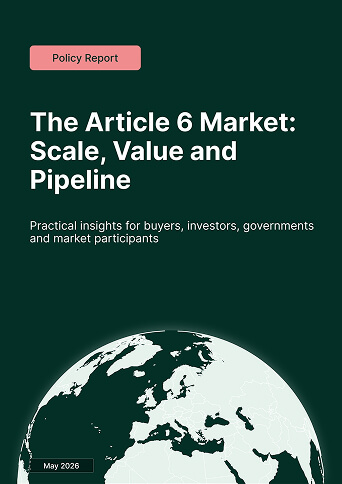
The Article 6 Market: Scale, Value and Pipeline
Article 6 is moving from policy design to market implementation, but progress remains uneven. Our new report reveals a market defined by early momentum, structural bottlenecks, and widening gaps between ambition and execution.
This report explores the key signals shaping the next phase of Article 6: from limited host country authorizations and constrained CORSIA demand, to tightening transition timelines under A6.4 and the emergence of three distinct market pathways. These findings offer a clearer view of where the market stands today, and what participants need to understand about what comes next.

Carbon Policy FAQs
Article 6 of the Paris Agreement establishes mechanisms for international cooperation to achieve global climate targets. It provides a framework for countries to trade carbon credits, allowing them to meet their nationally determined contributions (NDCs) while promoting sustainable development.
There are three primary mechanisms under Article 6:
Article 6.2: Bilateral/Multilateral Cooperation
Article 6.4: The Paris Agreement Crediting Mechanism
Article 6.8: Non-Market Approaches (NMAs)
Article 6.2 enables countries to trade carbon credits through bilateral or multilateral agreements. These credits, referred to as Internationally Transferred Mitigation Outcomes (ITMOs), are tracked and reported under a robust accounting framework to avoid double counting.
Article 6.2 offers flexibility and direct negotiation opportunities between countries, often leading to faster project approvals. It’s an avenue for businesses to engage in high-quality projects aligned with national climate policies and corporate sustainability goals.
Article 6.2 enables countries to trade carbon credits through bilateral or multilateral agreements. These credits, referred to as Internationally Transferred Mitigation Outcomes (ITMOs), are tracked and reported under a robust accounting framework to avoid double counting.
Article 6.2 offers flexibility and direct negotiation opportunities between countries, often leading to faster project approvals. It’s an avenue for businesses to engage in high-quality projects aligned with national climate policies and corporate sustainability goals.
Article 6.4 establishes a centralized market mechanism, overseen by the United Nations, to promote sustainable development and emissions reductions. It aims to replace the Clean Development Mechanism (CDM) from the Kyoto Protocol.
Projects under Article 6.4 are likely to benefit from high standards of transparency and robust methodologies. For commercial entities, it provides opportunities to participate in a regulated, globally recognized carbon market.
Unlike the bilateral nature of Article 6.2, Article 6.4 is a multilateral, standardized mechanism governed by a supervisory body under the UNFCCC. It ensures more stringent oversight and global consistency.
Supply/Demand dynamics among A6.2 mechanisms
Policymakers are assessing the complex landscape of international carbon credit transactions, to determine the source of credit generation approaches (supply), aligning them to demand centers and deciding whether to apply corresponding adjustments for any credits depending on use cases.
A mechanism ensuring that emission reductions are only counted once by adjusting the greenhouse gas (GHG) inventory of the host country to reflect transferred Internationally Transferred Mitigation Outcomes (ITMOs).
Example: If Country A transfers 5,000 ITMOs to Country B, it deducts 5,000 tons from its inventory.
Corresponding adjustments exists to avoid the issue of potential double counting in the market.
CORSIA stands for the Carbon Offsetting and Reduction Scheme for International Aviation. It is a global scheme designed to address CO2 emissions from international aviation. CORSIA is the first global market-based measure for any sector.
CORSIA aims to reduce emissions from international aviation in a harmonized way that minimizes market distortion. It achieves this by offsetting the CO2 emissions that cannot be reduced through technological advancements, operational improvements, and sustainable aviation fuels.
Participation in CORSIA is voluntary from 2021 to 2026. After 2026, participation becomes mandatory for most states, with some exceptions. As of 2024, 126 countries are participating in CORSIA, covering 64% of 2022 airline emissions. Airlines flying between these participating states must comply with CORSIA’s offsetting requirements.
The supply of EEUs for the First phase in its early stages remained very limited. As of October 2024, only 7 million fully authorised First phase credits are available, originating from an ART project in Guyana.
Millions of credits from other registries are eligible under ICAO’s criteria but have not received LoAs from their host countries, making them ineligible for the First phase. The limited supply raises concerns about whether CORSIA will function effectively as a market instrument.
Compliance carbon markets are regulated by governments or international agreements, where companies must meet legally binding emission reduction targets. Voluntary carbon markets, on the other hand, allow organizations to purchase carbon credits voluntarily to offset emissions beyond legal requirements. AlliedOffsets provides independent data across the voluntary carbon market, as well as the overlap between the two markets, to help buyers understand differences in pricing, quality, and regulatory exposure.
Voluntary carbon markets face several policy risks, including changes in host country regulations, export restrictions, retroactive approvals, and evolving international rules like Article 6. These risks can affect project eligibility, credit issuance, and market prices. AlliedOffsets tracks policy developments and incorporates risk indicators to help buyers and traders make informed decisions.
Evaluating country and political risks involves assessing factors such as government stability, environmental policy, export restrictions, and legal frameworks for carbon credit authorization. AlliedOffsets provides insights and country-level risk scoring, helping project developers, buyers, and investors understand potential obstacles before committing to a project.
Stay Updated on Policy Changes
Fill in the form below to set up a meeting with our expert carbon market team.
Data trusted by global organizations, news outlets and publications
Carbon Removal Startup Terradot Acquires Eion as Market Consolidates
Read the full story
Microsoft Feels the Heat as ‘Carbon Negative’ Goal Looms Nearer
Read the full story
UN attacks companies’ reliance on carbon credits to hit climate targets
Read the full story